Showing posts with label Advocacy Project. Show all posts

Monday, December 13, 2010

Advocacy Project:


Hey fellow bloggers!  I'm looking forward for you guys to try out today's challenge!  We have been talking about the amount of physical activity in adults- we should be getting a solid 30 minutes of moderate exercise for at least 3 times a week.  


So here's your challenge: How Fit Are You?  What better way to measure your own fitness level than by going out and doing it!  This shouldn't take too long, but make sure you do schedule some time to jump around at home or head to a gym near by.  The quiz at the end will ask questions that also pertain to your daily life in order to help you get 'the big picture.' Now grab a friend, roommate, or go ahead and try the following 5 tasks by yourself! 


Ready Begin:

  • Push-ups Lie facedown on floor, legs straight with toes curled under (no dropped knees, sorry) and arms bent so palms are flat on the floor directly beneath shoulders. Press up, keeping body in a straight line from head to ankle. Do as many in a row as you can—no time limit—and note the number.
  • Sit-ups Keep your knees bent, feet flat on the floor. Your shoulder blades should come up one third of the way to sitting upright. Do as many as you can in one minute or until you say uncle, whichever comes first! Write down the number.
  • Wall sit Stand with your back against a wall, feet hip-width apart about 12 inches away from wall. With feet planted, slide down until knees form a 90-degree angle. (Pretend you're in a chair.) Hold as long as you can, and time yourself.
  • Sit-and-reach Grab some masking tape and a yardstick. Place the yardstick on the floor, then take a foot-long piece of masking tape and stick it across the 15-inch mark to form a cross. Sit on the floor with legs extended in front of you on either side of the yardstick—the zero end facing you—so that bare heels touch the 15-inch tape mark. Keep feet slightly apart. Reach forward with both hands, bending at hips, and see the farthest mark your fingertips touch. Can you touch two inches past your heels? That means your reach is 17 inches. Measure your reach and make a note of the number.
  • 1.5-mile dash Map out a 1.5-mile loop— or we have an excellent indoor track here at UMD or feel free to head toward the nearest Starbucks—and lace up. Your mission: Cover the distance as fast as you can by walking, jogging, running or some combo, and time yourself.
Now to finish- please visit the following link and take the short quiz: How Fit Are You?  Make sure to read your results at the end!
________________________________________________________________________

Congratulations!  I'm proud of you and want to thank you for giving these tasks a try!  I hope you feel energized and hope that you learned a little bit of what your bodies can achieve. Push yourselves and keep on exercising! :o)

Monday, December 6, 2010

Advocacy Project: Letter to the Editor

December 6, 2010


President Barack Obama
The White House
1600 Pennsylvania Avenue NW
Washington, DC 20500


Focus Area 22: Physical Activity

    • Objective 22.2: Increase the proportion of adults who engage in moderate physical activity for at least 30 minutes per day 5 or more days per week or vigorous physical activity for at least 20 minutes per day 3 or more days per week.

Currently, a larger number of Americans are not getting the required daily exercise they need and obesity is on the rise.  As adults, we must learn to lead by example.  By not setting a balance, healthy lifestyle for ourselves, our children will easily follow into our footsteps.  They are susceptible to losing control of their own adult lives and become unhealthy with other diseases and health problems.  Physical inactivity causes a tremendous burden of disease and death.  Researchers commissioned by the President's Council on Physical Fitness and Sports coined the phrase 'Sedentary Death Syndrome.'o And no wonder. In 2000, the Journal of Applied Physiology reported that approximately "250,000 deaths per year in the United States are premature due to physical inactivity."  Physical inactivity is a major risk factor for developing forms of heart and cardiovascular diseases.  These can also contribute to further risks of obesity, high blood pressure, cholesterol problems, and diabetes.  These are all forms of long-term health problems.

Researchers pointed to evidence in adults that an increase in physical activity can help reduce and address symptoms of depression and anxiety.  Being physical active is a healthy habit with many benefits.  Regular physical activity can improve health and lower risks for diseases.  We must allow people of all ages into general fitness clubs.  Or at least allow them access to clubs that are open for those who can provide there own health care, but cannot provide their own membership at other popular organizations.

Thank you for your time.  We appreciate everything you have and continue to do for this country.  We hope to continue to move forward in bringing awareness of the importance of physical activity.  If I can provide any additional information or assistance please contact me at email@gmail.com or (123) 456-789.

Sincerely, 

Jamie Somrock


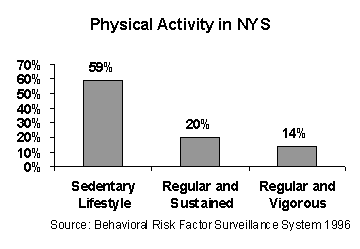
Sedentary Lifestyle: no reported activity or any physical activity or pair of activities done for less than 20 minutes or less than three times per week.
Regular and Sustained: any physical activity or pair of physical activities that are done for 30 minutes or more per session, five or more times per week, regardless of intensity.
Regular and Vigorous: any physical activity or pair of activities done for at least 20 minutes, at least three times per week, that requires rhythmic contraction of large muscle groups at 50% of functional capacity.
chart of physical activitiy levels in New York interpreted below
  • 59% of the New York population reported a sedentary lifestyle
    • 58% of men
    • 60% of women
    • The nonwhite population had a 6% higher level of sedentary lifestyle
  • 20% of the population meets the criteria for regular and sustained activity levels.
    • 21% of men
    • 19% of women
    • The nonwhite population had a 4% higher level of regular and sustained physical activity
  • 14% of the population meets the criteria for regular and vigorous activity levels.
    • 13% of men
    • 15% of women
    • The nonwhite population had a 5% higher level of regular and vigorous physical activity

Monday, November 22, 2010

Advocacy Project: Issue Overview

Introduction:
  • Focus Area 22: Physical Activity
    • Objective 22.2: Increase the proportion of adults who engage in moderate physical activity for at least 30 minutes per day 5 or more days per week or vigorous physical activity for at least 20 minutes per day 3 or more days per week. 
    • Goal: Improve health, fitness, and quality of life through daily physical activity.
  • Who is affected by the issue?
    • Currently, a large number of American are not getting the required daily exercise they need and obesity is on the rise.  I feel that not abiding by this rule/guideline will affect our children and generations to come.  As adults, we must learn to lead by example.  By not setting a balanced, healthy lifestyle for ourselves our children will easily follow into our footsteps.  They are susceptible to losing control of their own adult lives and become unhealthy with other diseases and health problems.
  • What are the consequences of the issue?
    • Physical inactivity is a major risk factor for developing forms of heart and cardiovascular diseases.  These can also contribute to further risks of obesity, high blood pressure, cholesterol problems, and diabetes.  These are all forms or long term health problems.
  • What is the economic impact of the issue?
    • Physical inactivity causes a tremendous burden of disease and death.  Researchers commissioned by the President's Council on Physical Fitness and Sports coined the phrase 'Sedentary Death Syndrome.'o And no wonder. In 2000, the Journal of Applied Physiology reported that approximately "250,000 deaths per year in the United States are premature due to physical inactivity."
  • What is the social impact of the issue?
    • Researchers pointed to evidence in adults that an increase in physical activity can help reduce and address symptoms of depression and anxiety.  "It seems that there is a psychological and physiological connection that help explain the beneficial effects of exercise on mental health," Kantomaa.
  • What are the barriers?
    • Studies investigating factors that may explain the high prevalence of leisure-time physical inactivity in the general population have indicated perceived barriers play a powerful role in keeping people from being or becoming physically active.  Analysis identified lack of motivation followed by lack of time as the only statistically significant (p<.01) predictors of membership in the physically inactive or active groups. That is, physically inactive subjects reported inadequate motivation and time as the reasons for undermining their ability to make regular physical activity a priority. Findings suggest that interventions for promoting increased leisure-time physical activity among the population group studied focus on creating strategies designed to help overcome the perceived intrapersonal constraints of lack of motivation and time.
  • What are the resources?
    • Being physical active is a healthy habit with many benefits.  Regular physical activity can improve health and lower risks for diseases.  Talk with a doctor or exercise specialist about starting an exercise program.  Have them help assess where you're starting out and where you should begin.  Set a goal that is realistic and achievable for your own personal situation and experience.
  • What is the history of the issue?
    • Prior to 1940 clubs focused on social and business networking.  Most memberships were for men and were not fitness focused.  In the mid 1940s, first appearing on the west coast, body building and weights began to appear at $60 per year.  1950's clubs became more prevalent; introduction of health club chains appeared in some larger cities.  Young Mens Christian Association (YMCA) was a popular one, who was more family-oriented.  1960s there was a rapid growth of health club chains.  They introduced the racquet club, which was still mainly run by men, and focused on weight training.  1970s there was emerging research geared towards fitness.  There was the introduction of multipurpose fitness clubs- new resistance training, aerobics, treadmills...People were now exercising for health!  The modern era (1980-2000), fitness was now recognized as an industry and served over 12 million people.  Personal training and group fitness came about.  The industry moved to a corporate model from a mom/pop model of doing business.
  • Allies & opponents:
    • Fitness clubs and health advocates will always work to promote physical activity in everyones' lives.  Injured people, low-income households may be opposed to physical activity since it is not readily available to them- It may be hard to incorporate into their daily lives due to cost.
  • Recommendation:
    • To allow people of all ages into certain fitness clubs.  Clubs that are open for those who can provide there own health care, but cannot provide their own membership at other popular organizations.

Monday, November 15, 2010

Advocacy Project: Healthy People/THOMAS

1. Focus Area 22:  Physical Activity

  • Goal: Improve health, fitness, and quality of life through daily physical activity.
  • Objective 22.2: Increase the proportion of adults who engage in moderate physical activity for at least 30 minutes per day 5 or more days per week or vigorous physical activity for at least 20 minutes per day 3 or more days per week.
  • Target of Objective: 32% of adults aged 18years and older engaged in moderate physical activity for at least 30 minutes per day or physical activity for at least 20 minutes per day in 1997

2. Objectives Continued:

  • In 2001, the language of objective 22.2 was changed after November 2000 publication to include adults who met the definition for vigorous physical activity.
  • Target revised from 30 because of baseline revision after November 2000 publication
  • Baseline revised from 15 after November 2000 publication
  • Target Method: Better than the best
  • Sponsor: Rep Altmire, Jason [PA-4] (introduced 6/4/2009)
  • Related Bills: H.RES.1373, S.RES.133, S.RES.515
  • Latest Major Action: 6/9/2009 Passed/Agreed to in House.  Status: On motion to suspend the ruled and agree to the resolution. Agreed to by voice vote.

Tuesday, November 9, 2010

Advocacy Project: My Political Representatives

Here is a list of my current political representatives:
(with current elections still in process, some may not be current)


Wednesday, September 22, 2010

Welcome to Jamie Says Jump...!


Hello everyone!  My name is Jamie.  I'm a senior this year & studying health education.  This blog is going to contain information of the environment & sustaining the world we live in...<3


There are 6 possible types of posts on my blog.  They include:
  1. Advocacy Project
  2. Eye Openers
  3. Reflections
  4. Eco-Chic Lifestyle Change
  5. Read 'n' Seed
  6. Share and Voice
MEMBERS: Brier S., Kristy S., Jamie S., Elly S., Lauren W., Mary X., Sarah Z.
  1. Brier@lovin nature with brier
  2. Kristy@kristys fun in the sun spot
  3. Jamie@jamie says jump
  4. Elly@elly dreams green
  5. Lauren@laurens pourin grain
  6. Mary@blue skies for mary
  7. Sarah@take a hike with sarah
You can subscribe to my blog by clicking the subscribe gadget in the gadget column.  You can also follow my blog by clicking "Follow this Blog" in the gadget column.  I am subscribed to all the blogs in my blog list gadget.  You can see my complete profile and all the blogs I am following by clicking on "See Complete Profile."

Hope you enjoyed!  Stay tuned for more information and fun adventures to follow!